Showing posts with label Ariadne Oliver. Show all posts

March 7, 2012

Dead Man's Folly

Rating: ***
A folly - I admit I always thought it meant a foolish mistake; apparently it is also some sort of structure! Dead Man's Folly features Hercule Poirot who is summoned peremptorily by the famous detective author Ariadne Oliver to Nasse House. Once he arrives at his destination, Mrs. Oliver tells him her fear: she thinks someone is working behind the scenes, manipulating her murder hunt, to bring about a real murder!

Poirot, never skeptical of his friend's insights, takes a look at the people assembled at Nasse House for the big fete. Things take a turn for the worse when Poirot, unable to avert the disaster, finds the body of young Marlene Tucker; the girl who had been playing the part of the victim is now the real victim. The key to the mystery, Poirot is certain, lies with Mrs. Folliat, the former owner of Nasse House who now lives in the lodge of her former residence. "There will always be Folliats at Nasse House", murmurs an old man. Some sort of message? or curse?

Mrs. Folliat is a unique character and holds the central interest. Being relegated to the outskirts of the house she was once mistress of, she still carries herself with self-assurance and is recognized as the mistress of Nasse House. What secrets she holds is for Poirot to discover - she won't reveal them.

Dead Man's Folly is mostly centered around relationships: the relationship between mother and child, and husband and wife. What people do for family and how much they are willing to accept. Hercule Poirot, always sympathetic, gives his little talks and tries to bring people together. I love his little match-making parts in the novels.

December 25, 2011

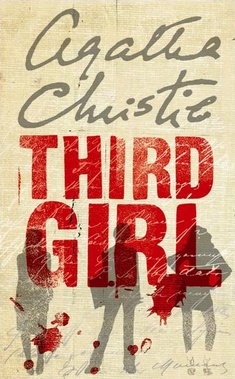
Third Girl

Rating: ***
A young girl who thinks she "might have committed a murder"  comes to consult Poirot at his flat one day. "You're too old" is how she leaves him, stunned yet intrigued. His ego may have been hurt, but more importantly, his curiosity is piqued. Who is this girl and why does she think she's murdered someone? Surely, one would know?

Poirot, with his infallible "grey cells" begins to track down this girl. He senses some impending danger - either to the girl or from the girl. What is the mystery? Who is this girl? Is she mad? Or delusional? Was the whole thing a joke? Somehow, Poirot doesn't think so and until he figures it out, he won't rest.

Some thoughts
This book reminded me of two other Agatha Christie books: Why Didn't They Ask Evans? and The Mirror Crack'd From Side to Side. Agatha Christie's style is somewhat repetitive. For one thing, she used the same device in both Why Didn't They Ask Evans and Third Girl: A person who believes they are suffering from cancer commit suicide, which actually turns out to be a very clever murder.

I think I'm developing a tortuous mind like Poirot.

This book featured one of my favorite characters in the Agatha Christie Universe, Dr. Stillingfleet. The loose-jointed, red-headed young doctor is a refreshing and endearing character. Really, it's because of his character that I enjoyed re-reading this book so much. Besides that, the novel had no extra brilliance that would recommend it.

December 7, 2011

The Clocks

Rating: ***
The Clocks by Agatha Christie has a huge cast that is just 'mentioned'. What I mean is that a lot of known characters from various novels are mentioned in this novel. Both Hastings and the crime writer Ariadne Oliver are mentioned. Poirot also refers to Miss Lemon. George, Poirot's valet features in this novel, along with the great detective himself. Finally, we have The Young Man in Love With One of the Woman Suspects (see my Agatha Christie page), Colin Lamb, who is hinted as being the son of one of Poirot's old friends; he is a major figure in the novel. With so many characters, you'd think the mystery would get lost somewhere in between.

Wilbraham Crescent, The Cavendish Secretarial Bureau, and a secret service agent - all are tied up with the mysterious happenings in house No. 19. On a certain day, they all unexpectedly collide when Sheila Webb comes screaming out of No. 19 straight into the arms of Colin Lamb. Apparently, she has seen a dead body.

The authorities hit a wall at the first step: the identity of the dead man. Till they can figure out who he is, Inspector Hardcastle and Colin Lamb have nothing to go upon. It's then that Colin Lamb brings his old friend Hercule Poirot onto the case.

Because of the apparent complexity of the case (four superfluous clocks are found on the scene; hence the title) Poirot is sure that the mystery itself must be exceedingly simple - they're just missing the obvious. When we get past the major thing blocking our advance: the dead man, it becomes what it is - a murdered man who is stripped of his identity with the killer sure he would not be easily identified. We get so caught up in the finding the identity that we, like the Inspector, don't wonder why it was so necessary to hide it!

Spoiler alert!
There were so many coincidences in this book! Sheila Webb is sent to the house where the murdered body lies; it also happens to be the place where her mother lives! A mother who gave her up when she was born. But that is not where it stops; the mother is also the very criminal master mind Colin Lamb had been searching for when he runs into Sheila Webb screaming out of the house (only he doesn't know it).

For people who know Agatha Christie inside-out.
Other things I noticed in The Clocks were too many near hits which turned into misses: people not recognizing faces, other people not recognizing a pattern - both things which could have helped solve the case faster. Then, I noticed a lot of repetition in this novel. Agatha Christie reused many of her devices e.g. a girl with a slow thinking process who has seen or "not seen" something (as the case may be) and hence ends up getting killed (happened in The Moving Finger). I think I'm noticing this because of reading too much Agatha Christie. I'm gonna have to stop awhile.

October 10, 2011

Cards on the Table

Rating: ****
Mr. Shaitana is no ordinary personality. He is a collector. Approaching Poirot one day, the Mephistopheles-like character invites him to a dinner party in which he will show case his unique collection - a collection of murderers; those murderers who have gotten away with their crimes.

Four crime experts; four supposed criminals; that is Mr. Shaitana's idea of a dinner party. Hercule Poirot meets Mrs. Oliver, the celebrated detective writer, Colonel Race, a Secret Service Agent, and Superintendent Battle from the Scotland Yard, all representatives of law and order. The other mysterious guests include murderers Dr. Roberts, Mrs. Lorrimer, Miss Anne Meredith, and Major Despard. At the end of a game of bridge, the crime experts come to take their leave of Mr. Shaitana, only to find him murdered. The only four in the room with Mr. Shaitana were the other four guests playing bridge. It is up to the others to find the murderer from within the murderers.

Some thoughts
The interesting thing about this case was that the authorities had absolutely no evidence to go upon. The deduction had to be purely psychological and Hercule Poirot is the king of psychology. The motive is obviously a previous murder that one of the guests thought Mr. Shaitana had discovered. Poirot reveals the purpose of the party to his law-enforcement friends and now they must discover the guests' previous murders as well as Mr. Shaitana's murderer.

This case also has the interesting feature of including four of Agatha Christie's most famous characters: Colonel Race, Superintendent Battle, Ariadne Oliver and of course Hercule Poirot. Each have starred in other novels but this is the only time when they all come together.

I was so tempted to rate this five stars. The only reason I didn't, was, that although the case was one of the best (even better than some five stars), none of the characters really moved me. It was psychologically intriguing but the story was not as touching as it was in Murder on the Orient Express or Death Comes as the End. But as I said, I'm tempted........

September 15, 2011

The Pale Horse

Rating: ****
On a foggy night, a certain Father Gorman is murdered after hearing the confession of a dying woman. Inspector Lejeune, the lead detective on the case, discovers a list of names hidden in the priest's shoe. What significance do those names bear? What is the connection of those names to the dying woman? Far away at a cafe in Chelsea, Mark Easterbrook, a historian, watches as two girls fight and one pulls out tufts of the other's hair. Later, he reads of the death of one of the girls.

By sheer coincidence, Mark Easterbrook comes into contact with the list of names. Slowly, he discovers that the list is a list of victims. The girl at the cafe, his god-mother, a friend etc. ...Were these people being blackmailed? Or something more sinister? What was the dying woman involved in?

Mark Easterbrook believes from the onset that the list contains the names of dead people. He finds that many of the names are known to him as of people who have recently died. This list becomes connected in his mind with a name: the "Pale Horse" (a hugely coincidental connection). Casually mentioned by an empty headed girl at lunch one day, the place apparently deals with murdering people for money. Shortly, he himself travels to the Pale Horse and meets Thyrza Grey, its mysterious owner. At first inclined to dismiss the superstition attached to the place as ridiculous, he finds himself horrified by the rantings of its occupants. Thyrza Grey apparently believes in the concept of being able to kill people by suggestion. A lot of scientific jargon popular in Christie's day is used and 'thought-waves' and 'mediums' are considered as the supernatural basis for the deaths as the victims - all rich - supposedly suffered a natural death.

The young historian finds himself in a curious position. He confides his suspicions to Ginger, a girl he met in the locality of the Pale Horse. Together, they hatch up a plan to approach the people involved as prospective clients. In a dangerous situation, it is in the end Inspector Lejeune who uncovers the true leader behind the ring.

Some thoughts
Re-reading was more fun than I thought. The Pale Horse had some interesting characters and a small romance to round it all off. I always enjoy Agatha Christie's depiction of characters. Mark Easterbrook, although somewhat credulous as far as 'thought-projection' and 'waves' are concerned, was a reliable and intelligent hero. He provides most of the narration in the novel which ends on the normal twist: whodunnit is never so simple in Agatha's mystery novels. It's the suspense that keeps you hooked till the end.

The Pale Horse is one of Agatha's later mysteries. Published in 1961, it contains famous characters Ariadne Oliver the detective fiction writer, Rev and Mrs. Dane Calthrop (also in The Moving Finger) and Colonel and Mrs. Despard (also in Cards on the Table).

I categorized this novel as one with the 'young couple'. Agatha Christie occasionally stereotyped her characters. This is most apparent in novels with Miss Marple, whose method consists of ascertaining 'types' of people. Although it was generally done with foreigners to make it easier for her readers to understand them, in my opinion it stretched to the protagonists in certain novels.