Showing posts with label George. Show all posts

February 22, 2014

After the Funeral

It's been sometime since I've read an Agatha Christie mystery. So long in fact that I'm out of the phase where I see similarities in all novels and can appreciate each one separately!
 
Rating: ***

After the Funeral is one of those mysteries that I always fail to appreciate. I can't like it although it is well written, and has a strong plot and character portrayal. It just doesn't sit right with me and I don't know why. Maybe it's the grey atmosphere, the sadness that somehow pervades the novel that I can't like. Whatever it is, After the Funeral is not one of my favorites.

It is a sad day (or is it?) when the family gets together to attend the funeral of Richard Abernethie, the eldest Abernethie. Having been wealthy beyond measure, the remaining relatives: a brother, a sister, two nieces and a nephew have only one thing on their minds - how much has he left them? In this 'solemn' atmosphere, the irrepressible Cora Lansquenet blurts out the revealing phrase "It's been hushed up very nicely ... but he was murdered, wasn't he?" 

So begins a maze of theories and suspicion....was he murdered? was it one of them? who was it? The initial doubt soon evaporates with the brutal murder of Cora herself. With another murder, the faithful old family lawyer, Mr. Entwhistle calls in a trusted friend: Hercule Poirot.

Who needed the money the most? Was it the brother - always inferior to his successful brother? or was it the sister - still resentful about the nonacceptance of her painter husband? It could be any one of the next generation - all in need of money for one reason or another (there is never a lack of motive in an Agatha Christie novel). Hercule Poirot must sift through the various motives to find the real murderer ...... someone who has been very clever, and yet not clever enough.


June 11, 2012

The Labours of Hercules

Rating: ***
Hercule Poirot has never doubted his abilities - until one day a parallel is drawn between him and his namesake the great Hercules of Greek lore..... To live up to (or in his own mind surpass!) the glory of Hercules, Poirot decides to take up the famous labours that the Greek hero went through. The twelve stories that follow are all that an Agatha Christie fan could wish for.

The novel contains some of the most famous characters in the Christie universe including Inspector Japp and Countess Vera Rosakoff. I enjoy this novel each time I read it because it has some of the simplest and sweetest stories Christie has written. Among them is The Arcadian Deer which tells the story of a young, handsome mechanic who is searching for the woman he fell in love with, The Augean Stables which concerns the reputation of a good and honest politician (really!); The Labours of Hercules also introduces the character Amy Carnaby - a timid old lady's companion who turns out to be something more. Of course there is also the final reappearance of Poirot's one and only flame Countess Vera Rosakoff. Now old and retired from a life of crime, in Poirot's eyes, she still has more fire than all the girls of the younger generation! All in all, reading these stories passes a fun couple of hours.

March 16, 2012

Dumb Witness

Rating: ***
The witness may be dumb, but so is Poirot when he receives a two month old letter from a woman who is now dead! Apparently the death was from natural causes, but coincidentally, old Emily Arundell had suspected someone from her family of trying 'to do away with her' on a previous occasion. Certainly the rewards would be great with four dependents standing to inherit a lot of money on her death. Imagine the surprise and consternation of the rest of the family when the money is left to Emily's annoying and dim-witted companion!

Not one of my favorite Hercule Poirot mysteries as you can see by my rating. I spent the entire time suspecting one person because of one clue; imagine my shock when it turned out to be the only person I hadn't suspected! I suddenly realized how Hastings must feel......

The deduction in the novel was sound and looking back I realize that Christie had paved the way for the identity of the murder. But not one I would want to read again any time soon.

March 7, 2012

Dead Man's Folly

Rating: ***
A folly - I admit I always thought it meant a foolish mistake; apparently it is also some sort of structure! Dead Man's Folly features Hercule Poirot who is summoned peremptorily by the famous detective author Ariadne Oliver to Nasse House. Once he arrives at his destination, Mrs. Oliver tells him her fear: she thinks someone is working behind the scenes, manipulating her murder hunt, to bring about a real murder!

Poirot, never skeptical of his friend's insights, takes a look at the people assembled at Nasse House for the big fete. Things take a turn for the worse when Poirot, unable to avert the disaster, finds the body of young Marlene Tucker; the girl who had been playing the part of the victim is now the real victim. The key to the mystery, Poirot is certain, lies with Mrs. Folliat, the former owner of Nasse House who now lives in the lodge of her former residence. "There will always be Folliats at Nasse House", murmurs an old man. Some sort of message? or curse?

Mrs. Folliat is a unique character and holds the central interest. Being relegated to the outskirts of the house she was once mistress of, she still carries herself with self-assurance and is recognized as the mistress of Nasse House. What secrets she holds is for Poirot to discover - she won't reveal them.

Dead Man's Folly is mostly centered around relationships: the relationship between mother and child, and husband and wife. What people do for family and how much they are willing to accept. Hercule Poirot, always sympathetic, gives his little talks and tries to bring people together. I love his little match-making parts in the novels.

December 31, 2011

Cat Among the Pigeons

Rating: ****

Meadowbank School for Girls is not just a school; it is a work of art. Miss Bulstrode contemplates her life long project and feels that it is now time to retire - when things are at their peak. But things are fast approaching a collision course when an international conspiracy, a killer, and a bag of jewels all converge; two weeks later, Miss Bulstrode sees her life's work lie in ruins about her with two murders occuring side by side. Things may have remained unresolved if Julia Upjohn, a student at the school, hadn't had the presence of mind to figure out the mystery, and call in the great Hercule Poirot.

Some thoughts
One of my favorite Agatha Christie novels, Cat Among the Pigeons has a lot of great characters. I love the unique teachers: Miss Rich who has genius and goes about with her hair falling about in disarray, and Miss Bulstrode, 'The Presence' whom all revere and fear; and the others: Mrs. Upjohn, a fond mother who is somewhat absent-minded, and has a weird sense of adventure (a friend of Mrs. Summerhayes who appears in Mrs. McGinty's Dead); and finally her daughter Julia Upjohn, who looks after her mother and is the only one smart enough to discover the mystery.

The ending may not have been as interesting as the rest of the novel, but it seemed natural. The expert deduction of Hercule Poirot wasn't as 'great' at it normally is and if I had been reading the novel for the first time, I would have been surprised by the identity of the killer. 

December 25, 2011

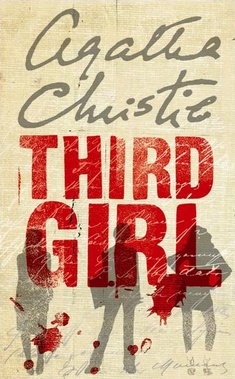
Third Girl

Rating: ***
A young girl who thinks she "might have committed a murder"  comes to consult Poirot at his flat one day. "You're too old" is how she leaves him, stunned yet intrigued. His ego may have been hurt, but more importantly, his curiosity is piqued. Who is this girl and why does she think she's murdered someone? Surely, one would know?

Poirot, with his infallible "grey cells" begins to track down this girl. He senses some impending danger - either to the girl or from the girl. What is the mystery? Who is this girl? Is she mad? Or delusional? Was the whole thing a joke? Somehow, Poirot doesn't think so and until he figures it out, he won't rest.

Some thoughts
This book reminded me of two other Agatha Christie books: Why Didn't They Ask Evans? and The Mirror Crack'd From Side to Side. Agatha Christie's style is somewhat repetitive. For one thing, she used the same device in both Why Didn't They Ask Evans and Third Girl: A person who believes they are suffering from cancer commit suicide, which actually turns out to be a very clever murder.

I think I'm developing a tortuous mind like Poirot.

This book featured one of my favorite characters in the Agatha Christie Universe, Dr. Stillingfleet. The loose-jointed, red-headed young doctor is a refreshing and endearing character. Really, it's because of his character that I enjoyed re-reading this book so much. Besides that, the novel had no extra brilliance that would recommend it.

December 7, 2011

The Clocks

Rating: ***
The Clocks by Agatha Christie has a huge cast that is just 'mentioned'. What I mean is that a lot of known characters from various novels are mentioned in this novel. Both Hastings and the crime writer Ariadne Oliver are mentioned. Poirot also refers to Miss Lemon. George, Poirot's valet features in this novel, along with the great detective himself. Finally, we have The Young Man in Love With One of the Woman Suspects (see my Agatha Christie page), Colin Lamb, who is hinted as being the son of one of Poirot's old friends; he is a major figure in the novel. With so many characters, you'd think the mystery would get lost somewhere in between.

Wilbraham Crescent, The Cavendish Secretarial Bureau, and a secret service agent - all are tied up with the mysterious happenings in house No. 19. On a certain day, they all unexpectedly collide when Sheila Webb comes screaming out of No. 19 straight into the arms of Colin Lamb. Apparently, she has seen a dead body.

The authorities hit a wall at the first step: the identity of the dead man. Till they can figure out who he is, Inspector Hardcastle and Colin Lamb have nothing to go upon. It's then that Colin Lamb brings his old friend Hercule Poirot onto the case.

Because of the apparent complexity of the case (four superfluous clocks are found on the scene; hence the title) Poirot is sure that the mystery itself must be exceedingly simple - they're just missing the obvious. When we get past the major thing blocking our advance: the dead man, it becomes what it is - a murdered man who is stripped of his identity with the killer sure he would not be easily identified. We get so caught up in the finding the identity that we, like the Inspector, don't wonder why it was so necessary to hide it!

Spoiler alert!
There were so many coincidences in this book! Sheila Webb is sent to the house where the murdered body lies; it also happens to be the place where her mother lives! A mother who gave her up when she was born. But that is not where it stops; the mother is also the very criminal master mind Colin Lamb had been searching for when he runs into Sheila Webb screaming out of the house (only he doesn't know it).

For people who know Agatha Christie inside-out.
Other things I noticed in The Clocks were too many near hits which turned into misses: people not recognizing faces, other people not recognizing a pattern - both things which could have helped solve the case faster. Then, I noticed a lot of repetition in this novel. Agatha Christie reused many of her devices e.g. a girl with a slow thinking process who has seen or "not seen" something (as the case may be) and hence ends up getting killed (happened in The Moving Finger). I think I'm noticing this because of reading too much Agatha Christie. I'm gonna have to stop awhile.